
Become HINDI
SPEAK LIKE A REAL NATIVE
AUTHENTIC INDIAN LIFESTYLE
From its early civilizations, including the Indus Valley Civilization, to its golden ages under powerful empires such as the Maurya Empire and the Mughal Empire, India has played a pivotal role in world history. Its rich cultural tapestry reflects influences from ancient Hindu and Buddhist traditions, as well as centuries of Islamic and later British rule, all blended into a deeply rooted and diverse heritage. With its stunning architectural legacy, from ancient temples and forts to iconic landmarks like the Taj Mahal, India offers a timeless journey through its dynamic and enduring cultural identity.
After gaining independence in 1947, India underwent a remarkable transformation. The nation embraced democratic governance and economic reforms, especially following liberalization in 1991, positioning itself as a major global player. Its thriving film industry, rapidly expanding tourism sector, and strong focus on education, science, and technology highlight a country that honors its past while building a dynamic future. Today, India stands as a bridge between tradition and modernity, celebrated for its linguistic diversity, cuisine, and resilient spirit.
We have created a selection of words and expressions that you won’t find in any textbook or course, to help you sound like a true local by understanding Hindi words that carry deeper cultural meaning, while also expanding your knowledge of the country and its history.
Speak and think like a real Indian!


EXPAND YOUR KNOWLEDGE
If you are serious about learning Hindi, we recommend that you download the Complete Hindi Master Course.
You will receive all the information available on the website in a convenient portable digital format as well as additional contents: over 15.000 Vocabulary Words and Useful Phrases, in-depth explanations and exercises for all Grammar Rules, exclusive articles with Cultural Insights that you won't find in any other textbook so you can amaze your Indian friends and business partners thanks to your knowledge of their country and history.
With a one-time purchase you will also get 10 hours of Podcasts to Practice your Hindi listening skills as well as Dialogues with Exercises to achieve your own Master Certificate.
Start speaking Hindi today!


AMRIT
अमृत [amrit] ("nectar of immortality") is a significant concept in Hindu mythology and religious symbolism. The word literally means “immortal” or “deathless” and refers to a divine substance believed to grant eternal life to those who consume it. In ancient Hindu texts, amrit appears as a sacred nectar associated with the gods and with the preservation of cosmic order.
The most well-known narrative involving amrit appears in the myth of समुद्र मंथन [samudra manthan] ("churning of the cosmic ocean"), described in several classical scriptures including the महाभारत [mahabharat] and the पुराण [puran] ("traditional Hindu mythological texts"). According to this story, the gods known as देव [dev] ("divine beings") and their rivals the असुर [asur] ("powerful supernatural adversaries") cooperated in churning the ocean of milk in order to obtain the nectar of immortality. Using the cosmic serpent वासुकी [vasuki] and the mountain मंदर [mandar], they churned the ocean until several sacred objects and beings emerged, including amrit.
When the nectar finally appeared, the gods feared that the asuras might seize it and gain immortality. To prevent this, विष्णु [vishnu] took the form of मोहिनी [mohini] ("divine enchantress") and distributed the nectar exclusively to the gods. One asura named राहु [rahu] attempted to disguise himself and drink the nectar, but he was discovered and punished, a story that later became associated with traditional explanations for eclipses in Hindu cosmology.
Beyond mythology, the idea of amrit has symbolic meaning in Indian philosophical traditions. It often represents spiritual knowledge, divine grace, or liberation from mortality. In devotional literature and religious poetry, spiritual teachings or sacred names may be described metaphorically as amrit because they are believed to lead to eternal spiritual fulfillment.
The concept also appears in religious rituals and language. Sacred water used in ceremonies may be described as अमृत जल [amrit jal] ("holy nectar-like water"), emphasizing its purifying and sanctifying qualities. Through these symbolic and mythological associations, amrit continues to represent the quest for immortality, divine blessing, and transcendence within the broader framework of Hindu religious thought.

ASHRAM
आश्रम [ashram] ("spiritual hermitage or monastic retreat") refers to a place where individuals dedicate themselves to spiritual practice, learning, and disciplined living. Traditionally, an ashram functions as a community centered around a spiritual teacher where disciples gather to study religious texts, meditate, and follow a structured lifestyle oriented toward self-development and devotion. These communities have existed in India for centuries and remain an important institution within Hindu religious culture.
In classical Indian tradition, ashrams were often located in natural surroundings such as forests or near rivers, providing an environment conducive to reflection and spiritual study. Early Hindu scriptures describe sages living in such hermitages where students would learn sacred knowledge and moral discipline. These communities were often led by a गुरु [guru] ("spiritual teacher") who guided disciples in religious philosophy, ethical conduct, and practices such as meditation and ritual worship.
The ashram also played an important role in the traditional system of education known as गुरुकुल [gurukul] ("residential teacher-student learning system"). In this system, students lived with their teacher and received instruction not only in religious texts but also in practical knowledge, moral values, and social responsibilities. Life in such communities emphasized discipline, service to the teacher, and the cultivation of humility and self-control.
In Hindu philosophical thought, the word ashram also refers to the four stages of life known as आश्रम व्यवस्था [ashram vyavastha] ("system of life stages"). These stages include ब्रह्मचर्य [brahmacharya] ("student stage"), गृहस्थ [grihastha] ("householder stage"), वानप्रस्थ [vanaprastha] ("retirement to spiritual life"), and संन्यास [sannyas] ("renunciation"). Each stage represents a different set of responsibilities and spiritual priorities throughout an individual’s life.
In modern times, ashrams continue to function as centers for spiritual learning and retreat. Many attract visitors seeking instruction in meditation, philosophy, or practices related to योग [yog] ("spiritual and physical discipline"). Although contemporary ashrams may vary in organization and structure, their fundamental purpose remains the cultivation of spiritual knowledge, ethical living, and inner discipline within a supportive communal environment.


CHOORI
चूड़ी [choori] ("decorative bracelet worn on the wrist") is a traditional ornament widely worn by women in India. Bangles are typically circular bracelets made from materials such as glass, metal, gold, silver, lacquer, or plastic. They are an important element of traditional Indian jewelry and are often associated with cultural customs, religious symbolism, and social identity.
In Indian cultural traditions, bangles are commonly worn in multiples on the wrist and are considered symbols of beauty, prosperity, and marital status. Married women in many communities wear specific sets of bangles as markers of marriage and good fortune. These ornaments are frequently worn together with other jewelry such as बिंदी [bindi] ("decorative mark worn on the forehead") and मंगलसूत्र [mangalsutra] ("marital necklace symbolizing marriage"), forming part of traditional attire.
Glass bangles are especially significant in many regions because of their distinctive sound when the wearer moves her hands. The gentle clinking of these ornaments is often associated with joy and domestic harmony. In wedding ceremonies, the wearing of bangles can form part of important rituals related to विवाह [vivah] ("marriage ceremony"), where they symbolize fertility and well-being for the bride.
The designs and materials used for bangles vary widely. Some are plain and minimal, while others feature elaborate carvings, enamel work, or gemstone decorations. Gold bangles are commonly worn during religious festivals and special events, while colorful glass bangles are popular in everyday wear. Traditional craftsmen produce these ornaments using techniques that have been passed down through generations.
Bangles are also frequently given as gifts during festivals and family celebrations. They appear in ceremonies connected with pregnancy, marriage, and religious observances, reflecting their broader role in Indian social life. During certain celebrations such as करवा चौथ [karva chauth] ("festival honoring marital devotion"), women often wear new bangles along with festive clothing and jewelry.
Today, bangles remain a prominent element of Indian fashion and cultural identity. While modern designs incorporate contemporary materials and styles, the ornament continues to hold traditional symbolic meaning linked to femininity, prosperity, and family life.


BASMATI
बासमती [basmati] ("aromatic long-grain rice") refers to a distinctive variety of rice traditionally cultivated in the Indian subcontinent and widely associated with Indian cuisine. The word derives from Hindi roots meaning “fragrant” or “full of aroma,” reflecting the characteristic scent released during cooking. Basmati is valued for its long, slender grains and its ability to remain separate and fluffy when prepared.
Basmati rice has been cultivated for centuries and is mentioned in historical agricultural records from northern India. Its distinctive qualities come from specific climatic conditions and soil composition found in certain parts of the region. The grain lengthens significantly during cooking, which makes it especially suitable for elaborate rice dishes and ceremonial meals.
In Indian culinary traditions, basmati is frequently used in dishes that combine rice with spices, vegetables, or meat. One of the most well-known preparations is बिरयानी [biryani] ("spiced rice dish with meat or vegetables"), where aromatic rice is layered with seasoned ingredients and cooked slowly to absorb flavor. Another common dish is पुलाव [pulaav] ("rice cooked with spices and vegetables"), in which basmati serves as the base for a lightly spiced meal.
The aroma and texture of basmati are often enhanced by cooking techniques that include rinsing and soaking the grains before boiling or steaming them. This preparation helps the rice maintain its long shape and prevents clumping. The rice is frequently served alongside dishes containing rich sauces or spice blends such as मसाला [masala] ("mixture of culinary spices"), which complement the mild flavor of the grain.
Basmati rice also plays an important role in festive and ceremonial meals. It is commonly prepared during family gatherings, religious celebrations, and wedding feasts where elaborate dishes are served to guests. Because rice is regarded as a staple symbol of nourishment and prosperity in Indian culture, basmati often appears in rituals and offerings associated with प्रसाद [prasad] ("food blessed through religious offering").
Today, basmati rice is exported worldwide and has become an internationally recognized ingredient of Indian cuisine. Despite its global popularity, it continues to be closely associated with traditional cooking practices and agricultural heritage in India, where it remains an essential component of many regional and national dishes.


BHAGAVAD GITA
भगवद्गीता [bhagavad gita] ("song of the divine") is one of the most important philosophical and religious texts in Hindu tradition. It forms part of the ancient Sanskrit epic महाभारत [mahabharat] ("great epic of ancient India") and appears in the section known as the Bhishma Parva. The text consists of a dialogue between the warrior prince अर्जुन [arjun] ("hero of the epic narrative") and the deity कृष्ण [krishna] ("divine guide and incarnation of Vishnu"), who serves as his charioteer on the battlefield.
The conversation takes place just before a major war begins. Arjun becomes troubled by the moral implications of fighting against relatives, teachers, and friends who stand on the opposing side. In response, Krishna explains the principles of duty, spiritual knowledge, and disciplined action. Through this dialogue, the text explores the nature of human responsibility and the importance of acting in accordance with धर्म [dharma] ("moral duty and cosmic order").
One of the central teachings of the Bhagavad Gita concerns the idea of performing actions without attachment to personal reward. This principle is known as कर्म योग [karma yog] ("path of disciplined action"). According to this teaching, individuals should fulfill their responsibilities with dedication while remaining detached from the outcomes. Such an approach allows a person to act ethically while maintaining spiritual awareness.
The text also discusses several other spiritual paths, including ज्ञान योग [gyan yog] ("path of knowledge") and भक्ति योग [bhakti yog] ("path of devotion"). These approaches emphasize different ways through which individuals can attain spiritual understanding and connection with the divine. Through these teachings, the Bhagavad Gita presents a comprehensive framework for ethical living, spiritual discipline, and philosophical reflection.
The Bhagavad Gita has influenced religious thought, literature, and philosophy in India for centuries. It has been interpreted by scholars, religious teachers, and political leaders as a guide to moral conduct and self-realization. Because of its concise yet profound exploration of duty, devotion, and spiritual insight, the text remains widely studied and quoted in discussions of Indian philosophy and Hindu religious practice.


BINDI
बिंदी [bindi] ("decorative forehead mark") is a traditional adornment worn on the center of the forehead, most commonly by women in India. The mark is usually placed between the eyebrows, a location that has long been associated in Indian spiritual traditions with inner awareness and concentration. Historically, the bindi was created using colored powder or paste, though modern versions are often adhesive ornaments made from fabric, plastic, or gemstones.
The word bindi derives from बिंदु [bindu] ("dot or point"), referring to the small circular shape traditionally used. In classical Hindu symbolism, the bindu represents the point of origin from which the universe emerges, giving the ornament both decorative and symbolic meaning. Over time, the mark became a visible cultural element associated with identity, spirituality, and aesthetics.
In many communities, the bindi has traditionally been worn by married women as a sign of marital status. It is often used together with other traditional symbols such as मंगलसूत्र [mangalsutra] ("sacred marital necklace") and चूड़ी [choori] ("decorative wrist bangles"). The red bindi in particular has been associated with prosperity and well-being within the household.
Beyond its social symbolism, the placement of the bindi is also linked with spiritual concepts. The area between the eyebrows is traditionally described as the location of the आज्ञा चक्र [agya chakra] ("energy center associated with insight") in yogic philosophy. Because of this association, the forehead mark has sometimes been interpreted as a symbol of concentration, wisdom, or spiritual perception.
In modern India, the bindi has evolved into a versatile fashion accessory worn by women of different backgrounds regardless of marital status. Designs range from simple colored dots to elaborate decorative pieces incorporating crystals and intricate patterns. The ornament frequently complements traditional clothing such as साड़ी [saari] ("traditional draped garment") or कुर्ता [kurta] ("loose traditional tunic").
Despite changes in fashion and social practice, the bindi continues to hold cultural significance. It remains one of the most recognizable visual elements of traditional Indian appearance, reflecting both aesthetic preference and historical symbolism rooted in Indian religious and cultural traditions.
BRAHMIN
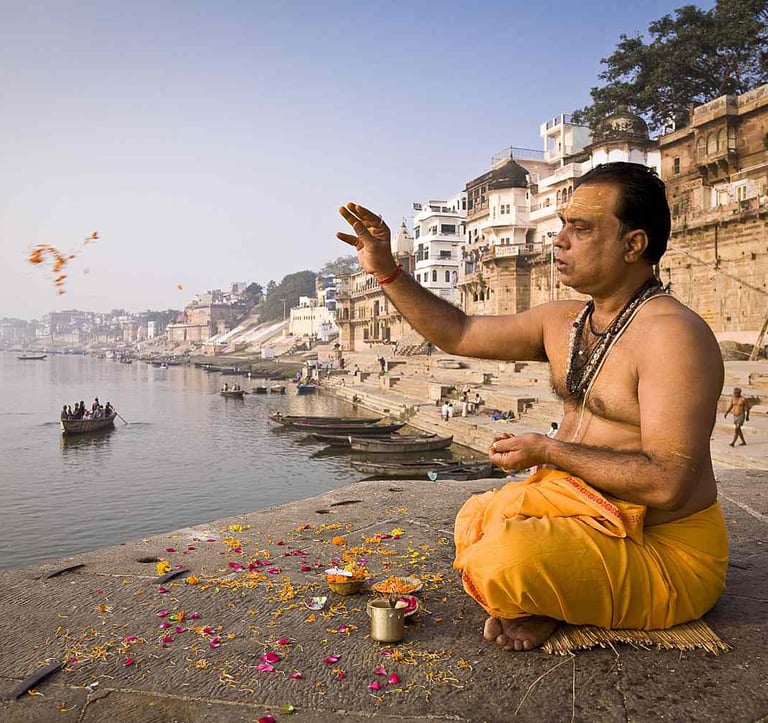
ब्राह्मण [brahman] ("member of the traditional priestly class") refers to a social and religious group historically associated with learning, priesthood, and the preservation of sacred knowledge in Hindu society. Within the traditional social framework known as वर्ण [varna] ("classical social category"), brahmins were regarded as the group responsible for religious instruction, ritual performance, and the study of sacred texts.
In ancient Indian tradition, brahmins were expected to devote themselves to the study and teaching of the वेद [ved] ("ancient sacred scriptures"). These texts contain hymns, rituals, and philosophical ideas that formed the foundation of early Hindu religious practice. Because the Vedas were transmitted orally for many centuries, brahmins played a crucial role in preserving their pronunciation, structure, and meaning.
Brahmins also traditionally served as ritual specialists who conducted ceremonies and sacrifices. They were responsible for performing rites such as यज्ञ [yajna] ("Vedic sacrificial ritual"), which involved offerings to the gods accompanied by recitations of sacred hymns. These rituals were believed to maintain harmony between the human world and the divine order.
The training of brahmins historically took place within educational institutions known as गुरुकुल [gurukul] ("traditional residential learning system"). Students lived with a teacher and received instruction in religious texts, language, philosophy, and ethical conduct. This system emphasized discipline, memorization, and respect for spiritual authority.
Over time, the role of brahmins expanded beyond ritual functions. Many became scholars, teachers, administrators, and advisors in royal courts. Their expertise in philosophy, literature, and law influenced the development of classical Indian intellectual traditions. Texts dealing with ethics, governance, and social conduct were often written or interpreted by scholars from brahmin backgrounds.
In modern India, the traditional social structure associated with the varna system has undergone significant transformation due to legal reforms, social movements, and economic changes. Nevertheless, brahmins continue to be associated with religious scholarship and the performance of rituals in many Hindu communities. Their historical role in preserving religious texts and philosophical traditions remains an important aspect of India’s cultural and intellectual heritage.


DHARMA
धर्म [dharma] ("moral duty and cosmic order") is one of the central concepts in Indian philosophical and religious traditions. The term refers to the principles that sustain order, justice, and harmony in the universe as well as in human society. Dharma encompasses ethical behavior, social responsibilities, and the natural laws believed to govern existence.
In classical Hindu thought, dharma represents the proper way of living according to one’s responsibilities and circumstances. It guides how individuals should act in relation to family, society, and the broader moral structure of the world. These duties may vary depending on factors such as age, occupation, and stage of life, but the underlying principle remains the maintenance of balance and righteousness.
Many traditional texts explore the meaning of dharma and its role in guiding human behavior. The concept is discussed extensively in the महाभारत [mahabharat] ("ancient Sanskrit epic") and the भगवद्गीता [bhagavad gita] ("philosophical dialogue on duty and action"). In these works, characters often face difficult moral decisions and must determine how to fulfill their obligations while remaining faithful to ethical principles.
Dharma is also closely connected with the concept of कर्म [karma] ("law of action and consequence"). According to this principle, actions performed in accordance with dharma generate positive results, while actions that violate moral duty create negative consequences. This relationship between ethical conduct and outcome reinforces the importance of responsibility and integrity in daily life.
In addition to its ethical dimension, dharma also refers to the universal order believed to sustain the cosmos. In this sense, it represents the underlying structure that allows the universe to function harmoniously. Religious rituals, social norms, and moral teachings are all understood as expressions of this broader cosmic balance.
The pursuit of dharma forms one part of the broader philosophical framework known as पुरुषार्थ [purusharth] ("four aims of human life"). Within this system, dharma exists alongside अर्थ [artha] ("material prosperity"), काम [kama] ("desire and enjoyment"), and मोक्ष [moksh] ("spiritual liberation"). Together these objectives outline a balanced approach to human life that integrates ethical conduct, social responsibility, and spiritual development.
Through centuries of religious and philosophical discussion, dharma has remained one of the most influential concepts in Indian thought, shaping ideas about justice, duty, and moral responsibility.


DHOTI
धोती [dhoti] ("traditional draped lower garment") is a long piece of cloth worn around the waist and legs, traditionally by men in many parts of India. The garment typically consists of a rectangular length of cotton fabric that is wrapped and folded in a specific manner to create a comfortable and secure form of clothing. Dhoti has been part of Indian dress for centuries and continues to be worn during religious ceremonies, cultural events, and in everyday life in some regions.
The garment is usually tied around the waist and then passed between the legs before being tucked into the waistband. This method allows the wearer to move easily while maintaining a structured appearance. Because the dhoti does not involve stitching, it represents an example of traditional unstitched clothing, a form of dress that has long been associated with ritual purity in Hindu customs.
Dhoti is often worn together with upper garments such as कुर्ता [kurta] ("loose traditional tunic") or अंगवस्त्र [angavastra] ("ceremonial cloth worn over the shoulders"). During religious rituals, priests and devotees frequently wear this attire because it is considered appropriate for sacred ceremonies. The garment is therefore commonly seen during पूजा [puja] ("ritual worship") and other temple activities.
In classical literature and temple art, many historical and mythological figures are depicted wearing dhotis. Kings, sages, and deities appear in sculptures and paintings dressed in variations of this garment. Because of its long history, the dhoti has become a recognizable symbol of traditional Indian clothing and cultural identity.
The garment also gained political symbolism during the twentieth century. Leaders of the Indian independence movement, including महात्मा गांधी [mahatma gandhi] ("leader of the Indian independence movement"), adopted simple dhoti clothing to emphasize modesty and solidarity with ordinary people. This choice of dress represented a rejection of foreign manufactured garments and a return to traditional textiles such as खादी [khadi] ("handspun cotton cloth").
Although modern clothing styles have become widespread in urban areas, the dhoti continues to be worn during religious ceremonies, weddings, and cultural celebrations. Its enduring presence reflects both practical comfort and its deep historical connection to Indian traditions of dress and ritual life.

DIWALI
दीवाली [diwali] ("festival of lights") is one of the most widely celebrated festivals in India and among Hindu communities worldwide. The name derives from दीपावली [deepavali] ("row of lamps"), referring to the traditional practice of lighting small oil lamps to symbolize the victory of light over darkness and knowledge over ignorance. The festival usually takes place in the autumn season according to the Hindu lunar calendar.
Diwali is associated with several religious narratives, the most widely known being the return of राम [ram] ("hero of the Ramayana epic") to his kingdom after defeating रावण [ravan]. According to the story, the people welcomed him by illuminating the city with rows of lamps, a tradition that continues during the festival. The celebration therefore represents the triumph of righteousness and the restoration of moral order.
Another important aspect of the festival involves the worship of लक्ष्मी [lakshmi] ("goddess associated with prosperity and fortune"). Families clean and decorate their homes, believing that a clean and well-lit house invites prosperity. During the evening, households perform पूजा [puja] to seek blessings for financial stability and success in the coming year.
The festival typically extends over several days and includes a range of social and cultural activities. Homes and streets are decorated with small clay lamps known as दीया [diya] ("oil lamp used in rituals"), as well as colorful floor patterns called रंगोली [rangoli] ("decorative designs made with colored powders"). Fireworks, festive meals, and the exchange of sweets are common features of the celebration.
Diwali also carries economic significance, as many businesses consider the festival an auspicious time for starting new financial accounts or making investments. Markets become especially active as people purchase gifts, clothing, and decorative items for their homes. The festival therefore plays an important role in both cultural and commercial life.
Although Diwali is primarily associated with Hindu traditions, it is also observed by members of other religious communities in different forms. Through its combination of religious ritual, family gatherings, and public celebration, the festival remains one of the most recognizable cultural events in India.


GANESHA
गणेश [ganesh] ("elephant-headed Hindu deity") is one of the most widely worshipped gods in Hindu tradition. He is traditionally regarded as the remover of obstacles, the patron of wisdom and learning, and the deity invoked at the beginning of important undertakings. Because of this role, prayers to Ganesha are commonly offered before starting ceremonies, journeys, or new ventures.
In Hindu mythology, Ganesha is the son of शिव [shiv] ("major Hindu deity associated with transformation") and पार्वती [parvati] ("goddess and consort of Shiva"). The most widely known legend describing his elephant head tells that Shiva unknowingly beheaded the child who was guarding Parvati’s chamber. To restore him to life, Shiva replaced the head with that of an elephant, giving Ganesha his distinctive appearance.
Ganesha is commonly depicted with a large elephant head, a round body, and four arms holding symbolic objects. These may include sweets, prayer beads, or ritual implements representing knowledge, prosperity, and spiritual discipline. His vehicle is traditionally a small mouse called मूषक [mooshak] ("mythological mouse mount of Ganesha"), which symbolizes the ability to overcome obstacles regardless of size.
The deity plays a central role in many religious ceremonies. During पूजा [puja] rituals, devotees offer flowers, incense, and sweets to seek blessings for success and protection. One of the sweets most closely associated with Ganesha is मोदक [modak] ("sweet dumpling offered to the deity"), which frequently appears as a ritual offering.
A major public celebration dedicated to the deity is गणेश चतुर्थी [ganesh chaturthi] ("festival celebrating the birth of Ganesha"). During this festival, elaborate clay images of the god are installed in homes and public spaces, worshipped for several days, and then ceremonially immersed in water. The celebration includes music, prayers, and community gatherings.
Ganesha’s role as a remover of obstacles has made him a universal symbol of auspicious beginnings in Hindu culture. His image appears at the entrance of temples, on manuscripts, and in artistic representations connected with education and creativity. Because of his association with wisdom and success, devotion to Ganesha remains one of the most widespread forms of worship in India.


GURU
गुरु [guru] ("spiritual teacher or guide") refers to a person who provides instruction, guidance, and knowledge within religious, philosophical, or artistic traditions in India. The term has long been associated with the transmission of sacred knowledge and the mentoring relationship between teacher and student. In many traditions, the guru is respected not only as an instructor but also as a spiritual authority who helps disciples develop moral discipline and understanding.
The concept of the guru is deeply rooted in the traditional system of education known as गुरुकुल [gurukul] ("residential teacher–student learning system"). In this system, students lived with their teacher and studied subjects such as sacred texts, language, philosophy, and ethical conduct. Learning occurred through close interaction with the teacher, who provided both intellectual instruction and guidance in daily behavior.
Within religious traditions, the guru often serves as an interpreter of sacred teachings. Students study philosophical texts such as the उपनिषद [upanishad] ("philosophical Hindu scriptures") under the supervision of a teacher who explains their meaning and helps disciples apply the teachings in practical life. This process emphasizes oral instruction, discussion, and long-term dedication to learning.
The relationship between teacher and student is often described using the word शिष्य [shishya] ("disciple or student"). The disciple shows respect and loyalty to the guru, while the guru provides knowledge and guidance. This relationship is considered an essential part of spiritual development because it connects theoretical learning with personal experience and ethical discipline.
The importance of teachers in Indian culture is reflected in celebrations such as गुरु पूर्णिमा [guru purnima] ("festival honoring spiritual teachers"). On this day, students express gratitude to their teachers through prayers, offerings, and acts of respect. The festival recognizes the role of teachers in preserving knowledge and guiding future generations.
Although the term guru originally referred to religious teachers, it has also been used more broadly to describe respected mentors in fields such as music, dance, philosophy, and other traditional arts. In these contexts, the guru remains a central figure responsible for preserving cultural knowledge and passing it on through direct instruction and disciplined practice.


HOLI
होली [holi] ("spring festival of colors") is a major Hindu festival celebrated across India and in many parts of the world. The festival marks the arrival of spring and symbolizes the triumph of good over evil as well as the renewal of social harmony. Holi usually takes place in the lunar month of Phalguna, typically during February or March.
One of the central elements of the celebration is the throwing of colored powders and water among participants. People gather in streets, courtyards, and public spaces to apply brightly colored powders known as गुलाल [gulaal] ("colored powder used during Holi celebrations"). This playful exchange of colors creates a festive atmosphere and temporarily removes social barriers, allowing people of different backgrounds to celebrate together.
The festival is also associated with a well-known mythological story involving the demon king Hiranyakashipu and his son Prahlad. According to the legend, Prahlad remained devoted to विष्णु [vishnu] despite his father’s opposition. Hiranyakashipu’s sister, Holika, attempted to harm Prahlad by sitting with him in a fire, but the plan failed and she was destroyed instead. The event is remembered through the ritual known as होलीका दहन [holika dahan] ("ceremonial bonfire before the Holi celebration"), performed on the evening before the main festivities.
Food also plays an important role during the festival. Families prepare special sweets and festive dishes to share with relatives and neighbors. One well-known treat associated with the celebration is गुजिया [gujiya] ("sweet pastry filled with dried fruits and nuts"), which is commonly prepared in many households.
Holi has also been linked with devotional traditions connected to कृष्ण [krishna] and his playful interactions with his companions in classical literature. These stories emphasize joy, friendship, and celebration as key aspects of the festival. Music, dancing, and community gatherings often accompany the colorful festivities.
Today, Holi remains one of the most widely recognized festivals in India. Through its combination of ritual, mythology, and communal celebration, the festival reflects themes of renewal, reconciliation, and the joyful arrival of the spring season.

KARMA
कर्म [karma] ("action and its consequences") is a fundamental concept in Hindu philosophy referring to the principle that every action produces a corresponding result. According to this idea, a person’s deeds influence future experiences, shaping both present circumstances and future outcomes. Karma therefore functions as a moral law connecting actions with their consequences.
In Hindu thought, karma is closely linked with the cycle of संसार [samsar] ("cycle of birth, death, and rebirth"). The actions performed in one life are believed to influence the conditions of future lives. Positive actions motivated by ethical intention may lead to favorable outcomes, while harmful actions can produce negative consequences. This connection emphasizes the importance of moral responsibility in everyday behavior.
The concept is also related to the idea of धर्म [dharma] ("moral duty and cosmic order"). Acting in accordance with dharma generates positive karma because such actions support harmony and justice. In contrast, actions that violate ethical principles create imbalance and may lead to suffering. Through this relationship, karma provides a framework for understanding moral accountability within the universe.
Hindu philosophical teachings often describe different categories of karma that accumulate over time. Some actions produce immediate effects, while others influence future experiences that may unfold gradually. Spiritual traditions emphasize that individuals can shape their destiny by cultivating ethical behavior, discipline, and awareness in daily life.
The pursuit of liberation from the cycle of karma is associated with the concept of मोक्ष [moksh] ("spiritual liberation from rebirth"). According to many philosophical schools, liberation occurs when a person transcends attachment to the results of actions and realizes the true nature of the self. This understanding is frequently discussed in spiritual teachings such as those found in the भगवद्गीता [bhagavad gita].
Today, the concept of karma remains widely recognized not only within Hindu philosophy but also in broader discussions of ethics and spirituality. Its central idea—that actions carry consequences—continues to influence moral reflection and cultural understanding both in India and around the world.


KUMBH MELA
कुंभ मेला [kumbh mela] ("large Hindu pilgrimage festival") is one of the largest religious gatherings in the world. The event takes place periodically according to the Hindu astrological calendar and attracts millions of pilgrims who gather to perform ritual bathing in sacred rivers. The festival is deeply connected with traditions of purification, devotion, and collective religious observance.
The name combines कुंभ [kumbh] ("sacred pot or vessel") and मेला [mela] ("religious fair or gathering"). The term refers to a mythological story associated with the समुद्र मंथन [samudra manthan] ("churning of the cosmic ocean"), during which a pot containing the nectar of immortality emerged. According to tradition, drops of this nectar fell at specific locations on earth, which later became the sites of the festival.
The central ritual of the kumbh mela is the ceremonial bathing known as स्नान [snan] ("ritual bathing for purification"). Pilgrims enter the river at astrologically significant moments, believing that the act cleanses spiritual impurities and helps remove the effects of negative karma. The event therefore represents a symbolic renewal of spiritual life.
Large groups of ascetics known as साधु [sadhu] ("Hindu ascetics devoted to spiritual practice") participate in the gathering. Many belong to organized monastic communities known as अखाड़ा [akhara] ("religious order of ascetics"). These groups often lead ceremonial processions before the ritual bathing begins, demonstrating the longstanding institutional structure of ascetic traditions.
The festival also functions as a major religious and social gathering where pilgrims attend sermons, devotional singing, and spiritual discussions. Temporary settlements are constructed to accommodate the enormous number of visitors, including facilities for worship, accommodation, and community services.
Kumbh mela occurs in different locations and cycles determined by planetary positions described in traditional astrology known as ज्योतिष [jyotish] ("Hindu astrological system"). Because of its scale and spiritual significance, the event has become one of the most remarkable examples of collective religious practice in the world.
Today, the kumbh mela continues to attract millions of participants from across India and abroad. Through ritual bathing, religious gatherings, and spiritual discourse, the festival represents a powerful expression of faith and communal devotion within Hindu culture.

MAHABHARATA
महाभारत [mahabharat] ("great epic of ancient India") is one of the longest and most influential works of literature in Hindu tradition. The epic is traditionally attributed to the sage व्यास [vyas] ("legendary author and compiler of sacred texts") and is believed to have been composed over several centuries. It contains more than one hundred thousand verses and presents a complex narrative that combines mythology, history, philosophy, and moral reflection.
The central story of the Mahabharata revolves around a conflict between two branches of a royal family known as the कौरव [kaurav] ("the Kaurava brothers") and the पांडव [pandav] ("the Pandava brothers"). Their rivalry leads to a large-scale war fought on the battlefield of Kurukshetra. The epic explores the causes and consequences of this conflict while examining themes of duty, justice, and leadership.
Within the larger narrative appears the philosophical dialogue known as the भगवद्गीता [bhagavad gita] ("sacred philosophical dialogue between Krishna and Arjuna"). In this section, the warrior अर्जुन [arjun] receives guidance from कृष्ण [krishna] about moral responsibility, spiritual knowledge, and the proper way to perform one’s duty. The teachings presented in this dialogue have become central to Hindu philosophical thought.
The Mahabharata contains numerous stories, legends, and moral discussions that illustrate the complexity of ethical decision-making. Characters in the epic frequently confront situations where they must choose between conflicting responsibilities connected with धर्म [dharma] ("moral duty and cosmic order"). Through these narratives, the epic explores the challenges of maintaining righteousness in difficult circumstances.
Beyond its narrative content, the Mahabharata functions as an important cultural and philosophical text. It includes discussions about politics, social values, spiritual practice, and human relationships. Many later works of literature, art, and performance traditions draw inspiration from its stories and characters.
Today, the Mahabharata continues to influence religious thought, storytelling, and cultural traditions throughout India. Its narratives are retold through theatrical performances, television adaptations, and classical dance interpretations. As one of the foundational texts of Indian civilization, the epic remains a major source of philosophical insight and cultural identity.


MANDALA
मंडल [mandal] ("sacred geometric diagram") refers to a symbolic diagram used in religious, philosophical, and artistic traditions in India. Mandalas are typically composed of geometric patterns arranged around a central point and are often used to represent the structure of the universe or the organization of spiritual reality. These designs appear in ritual practices, meditation traditions, and decorative art.
In Hindu religious contexts, mandalas may serve as visual representations of cosmic order. The central point symbolizes the origin of creation, while the surrounding patterns represent layers of the universe. This arrangement reflects philosophical ideas about the relationship between the individual and the cosmos, themes frequently explored in texts such as the उपनिषद [upanishad] ("philosophical Hindu scriptures").
Mandalas are often created as part of ritual activities connected with पूजा [puja] ("ritual worship"). During certain ceremonies, practitioners draw geometric patterns on the ground using colored powders, grains, or flowers. These temporary designs function as sacred spaces where ritual offerings and prayers are performed.
The concept of the mandala is also associated with meditation and spiritual concentration. In some traditions, practitioners focus their attention on the symmetrical patterns to support contemplation and mental discipline. The structured design encourages reflection on the interconnected nature of the universe and the individual’s place within it.
Beyond religious practice, mandala patterns appear in architecture, sculpture, and decorative arts. Temple layouts sometimes incorporate geometric planning inspired by mandala designs, reflecting the belief that sacred structures should mirror cosmic order. These patterns therefore influence both artistic expression and religious symbolism.
Today, mandalas continue to be used in spiritual traditions and artistic contexts. Their geometric structure and symbolic meaning have made them widely recognized representations of balance, harmony, and the organization of the cosmos within Indian cultural traditions.

MANTRA
मंत्र [mantra] ("sacred sound or formula used in spiritual practice") is a word, phrase, or sequence of syllables recited in religious and meditative traditions in India. Mantras are believed to possess spiritual significance and are used to focus the mind, express devotion, or invoke divine presence during rituals and meditation.
The use of mantras can be traced to the ancient वेद [ved] ("sacred scriptures of early Hindu tradition"), where hymns and sacred formulas were recited during ritual ceremonies. These texts preserved many of the earliest mantras, which were transmitted orally from teacher to student with careful attention to pronunciation and rhythm.
In spiritual practice, mantras are often repeated as part of a meditative discipline known as जप [jap] ("repetition of sacred mantra"). Through repeated recitation, practitioners aim to calm the mind and cultivate concentration. The rhythmic repetition of a mantra is believed to help direct attention toward spiritual reflection.
Many mantras are associated with particular deities or philosophical concepts. For example, the sacred syllable ॐ [om] ("primordial sacred sound") is regarded as a representation of the fundamental vibration of the universe. Other mantras may include longer verses praising divine figures or expressing spiritual aspirations.
Mantras are frequently recited during rituals such as पूजा [puja] ("ritual worship") and fire ceremonies. In these contexts, the recitation accompanies offerings made to deities and helps structure the sequence of the ritual. The sound of the mantra is considered an important element of the ceremony.
Beyond religious rituals, mantras are also used in personal spiritual practices such as meditation and yoga. Practitioners may repeat a chosen mantra silently or aloud as a method of maintaining mental focus and cultivating inner awareness.
Today, mantras continue to play a central role in Hindu religious life and spiritual practice. Their use in prayer, ritual, and meditation reflects a long-standing belief that sound and language can serve as powerful tools for spiritual concentration and devotion.


MASALA
मसाला [masala] ("blend of spices used in cooking") refers to a mixture of spices commonly used in Indian cuisine to flavor food. The word can describe both dry spice blends and pastes made by grinding spices with other ingredients such as garlic, ginger, or oil. Masala plays a central role in Indian cooking, where combinations of spices are used to create distinctive flavors and aromas.
Traditional masala mixtures may include spices such as cumin, coriander, turmeric, chili, and cardamom. These ingredients are often roasted or ground together to produce balanced flavor profiles. The specific composition of a masala blend varies depending on the dish being prepared and regional culinary traditions.
One well-known example is गरम मसाला [garam masala] ("aromatic warming spice blend"). This mixture usually contains spices such as cloves, cinnamon, cardamom, and black pepper. It is typically added toward the end of cooking to enhance aroma and depth of flavor in a dish.
Masala mixtures are widely used in the preparation of both vegetarian and meat-based foods. They appear in dishes such as करी [kari] ("spiced stew or sauce") and rice preparations made with बासमती [basmati] ("aromatic long-grain rice"). The combination of spices allows cooks to adjust flavor intensity, heat, and fragrance according to preference.
The preparation of masala blends often reflects family traditions and regional cooking styles. In many households, spices are freshly ground using traditional tools rather than purchased as pre-mixed powders. This practice helps preserve the aroma and freshness of the ingredients.
Beyond their culinary value, spices used in masala blends are also associated with traditional dietary knowledge. In आयुर्वेद [ayurved] ("classical Indian system of medicine"), many spices are believed to support digestion and maintain bodily balance when used appropriately in food.
Today, masala remains an essential element of Indian cooking. Its varied combinations of spices contribute to the rich diversity of flavors that characterize the cuisine and reflect centuries of culinary knowledge and tradition.

NIRVANA
निर्वाण [nirvan] ("state of liberation from suffering and rebirth") refers to a spiritual state associated with the complete cessation of suffering and the end of the cycle of rebirth. The concept appears in several Indian philosophical and religious traditions, particularly Buddhism and certain Hindu philosophical discussions. Nirvana represents a condition in which attachment, ignorance, and desire are overcome.
In Buddhist teachings, nirvana is the ultimate goal of spiritual practice. It is attained when a person fully understands the nature of reality and eliminates the causes of suffering described in the चार आर्य सत्य [char arya satya] ("Four Noble Truths"). These teachings explain that suffering arises from craving and attachment and can be ended through disciplined spiritual practice.
The path leading to nirvana is described in the अष्टांग मार्ग [ashtang marg] ("Eightfold Path"), which outlines ethical conduct, mental discipline, and wisdom as essential elements of spiritual development. Through practices such as meditation and mindful living, individuals gradually reduce attachment and ignorance.
The concept is also related to the broader idea of the cycle of rebirth known as संसार [samsar] ("cycle of birth, death, and rebirth"). In many Indian philosophical traditions, existence within this cycle is characterized by impermanence and suffering. Nirvana represents the end of this cycle, freeing the individual from repeated rebirth.
Nirvana is often described in philosophical terms rather than through concrete imagery. It is understood as a state beyond ordinary categories of existence and nonexistence. Because of this, classical texts frequently explain nirvana through metaphors that emphasize peace, freedom, and the absence of suffering.
Today, the concept of nirvana remains central to Buddhist philosophy and continues to influence broader discussions of spirituality and liberation in Indian intellectual traditions. It represents the aspiration for complete freedom from suffering and the realization of ultimate spiritual understanding.


OM
ॐ [om] ("sacred primordial sound") is one of the most important symbols and sounds in Hindu spiritual tradition. It is considered a sacred syllable representing the fundamental vibration of the universe and is widely used in prayer, meditation, and religious rituals. The sound Om is often recited at the beginning and end of spiritual practices as a way of focusing the mind and invoking a sense of sacred presence.
In Hindu philosophy, Om is associated with the ultimate reality known as ब्रह्म [brahm] ("absolute universal reality"). The syllable is believed to symbolize the essence of all existence, encompassing creation, preservation, and transformation. Because of this symbolic meaning, Om is frequently regarded as a condensed representation of spiritual truth.
The sound itself is traditionally described as consisting of three components: “A,” “U,” and “M.” These elements are interpreted as representing different aspects of cosmic reality. Some philosophical explanations associate them with the divine triad known as the त्रिमूर्ति [trimurti] ("threefold manifestation of the divine"), which includes ब्रह्मा [brahma], विष्णु [vishnu], and शिव [shiv]. Through this interpretation, the sound reflects the cycles of creation, preservation, and transformation in the universe.
Om is also widely used in meditation practices connected with योग [yog] ("discipline of physical and mental practice"). Practitioners may chant the syllable repeatedly while focusing on breathing and concentration. The vibration produced by the sound is believed to support mental calm and awareness.
In religious rituals, Om often appears at the beginning of sacred formulas known as मंत्र [mantra] ("sacred recited formula used in worship"). Its inclusion in these recitations is intended to sanctify the prayer and align it with spiritual intention.
Today, the symbol of Om is widely recognized as a representation of Indian spiritual tradition. It appears in religious art, temple architecture, and devotional literature. Through its association with sacred sound and cosmic unity, Om continues to represent the idea that the universe itself is grounded in a fundamental spiritual principle.

PANEER
पनीर [paneer] ("fresh Indian cheese made from curdled milk") is a widely used dairy product in Indian cuisine. It is a non-aged cheese produced by curdling hot milk with an acidic ingredient such as lemon juice or vinegar. The curds are then separated from the whey, pressed into a solid block, and cut into cubes or slices for cooking.
Paneer has a mild flavor and a firm texture that allows it to retain its shape when heated. Unlike many Western cheeses, it does not melt when cooked. This characteristic makes it suitable for frying, grilling, or simmering in sauces. Because of its versatility, paneer is frequently used in a variety of vegetarian dishes.
One well-known preparation is पालक पनीर [palak paneer] ("paneer cooked in spinach-based sauce"). In this dish, cubes of paneer are combined with a puree of spinach and spices to create a rich and flavorful meal. Another popular dish is मटर पनीर [matar paneer] ("paneer cooked with peas in spiced gravy"), where the cheese is simmered in a tomato-based sauce.
Paneer plays an important role in vegetarian cooking in India because it provides a source of protein in meals that do not include meat. It is often used in curries, stuffed breads, and grilled dishes prepared with spice mixtures such as मसाला [masala] ("blend of spices used in cooking"). The mild flavor of paneer allows it to absorb the seasonings used in these preparations.
In addition to savory dishes, paneer can also appear in desserts. It may be used to prepare sweets such as रसगुल्ला [rasgulla] ("sweet dumplings made from fresh cheese") and other milk-based confections that combine cheese with sugar syrup.
Today, paneer remains one of the most recognizable ingredients in Indian cuisine. It is prepared in homes, restaurants, and food stalls throughout the country, reflecting the long-standing importance of dairy products in Indian culinary traditions.


SAMOSA
समोसा [samosa] ("fried pastry filled with spiced ingredients") is a popular savory snack widely consumed in Indian cuisine. The dish consists of a triangular pastry shell filled with a mixture of spiced ingredients and then deep-fried until crisp. Samosas are commonly served as snacks in homes, restaurants, and street food stalls.
The outer shell of the samosa is made from wheat flour dough that is rolled into thin sheets and shaped into triangular pockets. These pockets are filled with a mixture that often includes mashed potatoes, peas, and spices. After filling, the pastry is sealed and fried in hot oil until the exterior becomes golden and crisp.
Spices used in the filling typically include cumin, coriander, chili, and other ingredients blended as मसाला [masala] ("blend of spices used in cooking"). These spices give the filling its distinctive flavor and aroma. The combination of crispy pastry and seasoned filling makes the snack widely appreciated for its texture and taste.
Samosas are often served with dipping sauces such as चटनी [chutni] ("spiced condiment or sauce"). Common varieties include tamarind chutney, which has a sweet and tangy flavor, and mint chutney, which provides a fresh and slightly spicy taste. These condiments enhance the overall flavor of the snack.
The dish is commonly eaten as a quick snack during the day or served to guests as part of hospitality. It is frequently accompanied by beverages such as चाय [chai] ("spiced tea beverage"). This combination of tea and savory snacks is a familiar feature of social gatherings in many Indian households.
Today, samosas are widely available in food stalls, restaurants, and bakeries throughout India and in many other parts of the world. Although variations of the filling exist, the triangular fried pastry remains one of the most recognizable snacks in Indian culinary tradition.
SAMSARA
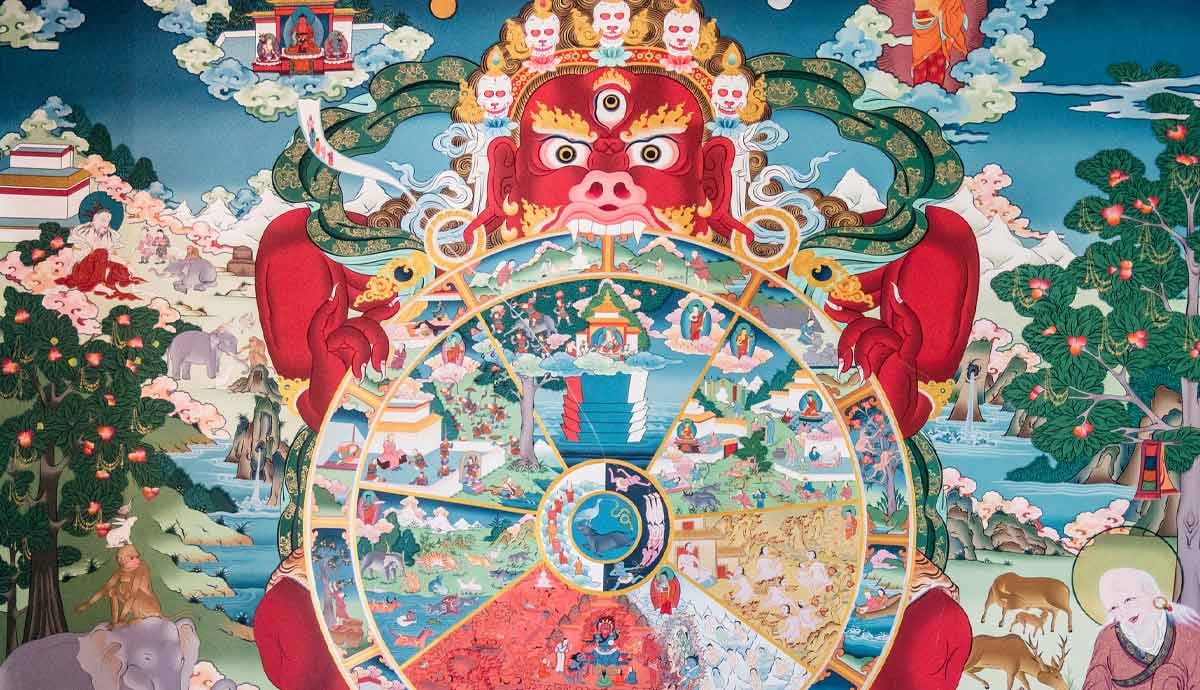
संसार [samsar] ("cycle of birth, death, and rebirth") is a fundamental concept in several Indian philosophical and religious traditions. The term refers to the continuous cycle through which living beings are born, die, and are reborn. According to traditional belief, this cycle is governed by moral causation and continues until spiritual liberation is achieved.
In Hindu philosophy, samsara is closely connected with the principle of कर्म [karma] ("action and its consequences"). Actions performed in one lifetime influence future experiences and determine the circumstances of future births. Positive actions guided by ethical intention may lead to favorable conditions, while harmful actions may produce suffering.
The continuation of samsara is also associated with attachment and ignorance about the true nature of reality. Spiritual teachings emphasize that individuals remain bound to this cycle as long as they identify with temporary desires and material attachments. Overcoming these limitations is considered essential for spiritual progress.
The ultimate goal in many Hindu philosophical traditions is to achieve मोक्ष [moksh] ("spiritual liberation from the cycle of rebirth"). Liberation occurs when an individual realizes the true nature of the self and becomes free from the effects of karma. At this point, the cycle of repeated birth and death comes to an end.
Discussions of samsara appear in several classical texts, including the उपनिषद [upanishad] ("philosophical scriptures exploring the nature of reality"). These writings explore questions about the nature of the soul, the universe, and the path toward spiritual freedom.
Today, the concept of samsara remains an important part of Indian philosophical thought. It provides a framework for understanding the relationship between human actions, ethical responsibility, and the long-term consequences of behavior across lifetimes.


TANDOOR
तंदूर [tandoor] ("traditional clay oven used for cooking") is a cylindrical clay oven widely used in Indian cuisine. The oven is typically built from clay or metal and is heated with charcoal or wood placed at the bottom. Its high internal temperature allows food to cook quickly while developing a distinctive smoky flavor.
The design of the tandoor enables heat to circulate evenly within the oven. Food is placed either on long metal skewers or directly on the inner walls of the oven. The intense heat seals the outer surface of the food while keeping the inside tender and flavorful.
One of the most well-known foods prepared in a tandoor is तंदूरी चिकन [tandoori chicken] ("chicken marinated with spices and roasted in a tandoor"). The meat is typically marinated in yogurt and spices before cooking, which helps tenderize it and enhance its flavor during roasting.
Flatbreads are also commonly prepared in this oven. Bread such as नान [naan] ("leavened flatbread baked in a tandoor") is placed directly against the hot inner wall of the oven. The dough quickly bakes and develops a slightly charred surface that gives the bread its characteristic texture.
Spice mixtures used for marinating foods cooked in the tandoor often include ingredients combined as मसाला [masala] ("blend of spices used in cooking"). These spice blends contribute to the rich aroma and distinctive taste associated with tandoori dishes.
Although traditional tandoors were commonly used in villages and households, modern restaurants have also adopted this cooking method. The oven remains an important tool in both traditional and contemporary kitchens.
Today, the tandoor is recognized as a central element of Indian culinary tradition. Its ability to produce distinctive flavors and textures has made it widely used in restaurants around the world that specialize in South Asian cuisine.


YOGA
योग [yog] ("discipline of physical, mental, and spiritual practice") refers to a system of practices and philosophical teachings that originated in ancient India. The term derives from a Sanskrit root meaning “to join” or “to unite,” reflecting the idea of connecting the individual self with deeper spiritual awareness. Yoga includes physical exercises, breathing techniques, meditation, and ethical principles designed to cultivate balance and self-discipline.
The philosophical foundation of yoga is described in classical texts such as the योग सूत्र [yog sutra] ("aphorisms outlining the philosophy of yoga"), traditionally attributed to पतंजलि [patanjali]. These teachings present yoga as a method for calming the mind and achieving insight into the true nature of consciousness.
A key element of this system is the framework known as अष्टांग योग [ashtang yog] ("eightfold path of yoga practice"). This framework outlines stages of spiritual development that include ethical conduct, disciplined behavior, physical posture, breath regulation, concentration, meditation, and deep contemplation. Together these stages guide practitioners toward mental clarity and spiritual understanding.
Physical postures practiced in yoga are known as आसन [asan] ("body posture used in yoga practice"). These positions are combined with breathing techniques called प्राणायाम [pranayam] ("controlled breathing discipline"). The combination of posture and breath helps develop physical stability and mental focus.
Yoga is closely connected with broader philosophical ideas found in Indian spiritual traditions. The ultimate aim of many yoga practices is to move toward मोक्ष [moksh] ("spiritual liberation from the cycle of rebirth"). Through disciplined practice, individuals seek freedom from mental disturbances and deeper awareness of the self.
Today, yoga is practiced throughout the world in both traditional and modern forms. While contemporary practice often emphasizes physical exercise and relaxation, the discipline continues to reflect ancient philosophical ideas about self-awareness, balance, and the pursuit of inner harmony.


EXPAND YOUR KNOWLEDGE
If you are serious about learning Hindi, we recommend that you download the Complete Hindi Master Course.
You will receive all the information available on the website in a convenient portable digital format as well as additional contents: over 15.000 Vocabulary Words and Useful Phrases, in-depth explanations and exercises for all Grammar Rules, exclusive articles with Cultural Insights that you won't find in any other textbook so you can amaze your Indian friends and business partners thanks to your knowledge of their country and history.
With a one-time purchase you will also get 10 hours of Podcasts to Practice your Hindi listening skills as well as Dialogues with Exercises to achieve your own Master Certificate.
Start speaking Hindi today!
For requests or suggestions: pr@indian-institute.com


Learn the official language of India in 30 days thanks to the most complete Grammar, Vocabulary and Culture courses available.
Start speaking Hindi today!
© Copyright 2026 Indian Institute
Come visit India!