Torture by Design? Why India’s Laws Are Not Enough
Custodial violence in India persists as a structural problem despite legal safeguards and rare convictions
During a visit to a police office in Bengaluru, the author noticed a striking image: a uniformed officer overpowering a raging bull. The symbolism reflected an institutional mindset where policing is seen as domination and control. This deeply embedded institutional imagination (संस्थागत कल्पना) [sansthaagat kalpana] helps explain why custodial violence (हिरासत में हिंसा) [hiraasat mein hinsa] in India is not an isolated occurrence but a recurring feature of law enforcement practices.
The issue returned to public attention following the judgment in the custodial torture and deaths of P. Jayaraj and P. Bennix in 2020. The father and son were detained for violating COVID-19 curfew rules, but what followed, according to official records, was prolonged abuse involving beatings, sexual violence and severe injuries. They were even forced to clean evidence of their own torture. Their deaths sparked widespread outrage, turning the case into a symbol of police brutality (पुलिस बर्बरता) [police barbarata] and systemic failure.
The investigation was transferred to the Central Bureau of Investigation rather than handled by the local police, whose officers were accused. This distinction proved crucial. The agency concluded that the injuries inflicted were sufficient to cause death, leading to the conviction of nine officers nearly six years later. The court sentenced them to death under the “rarest of rare” doctrine, a decision seen by many as a rare instance of judicial accountability (न्यायिक जवाबदेही) [nyaayik javaabdehi] in cases of custodial abuse.
However, the case stands out precisely because it is an exception. Data from the National Human Rights Commission recorded 1,723 custodial deaths in 2019 alone, nearly five per day. Yet between 2011 and 2022, not a single police officer was convicted in over 1,100 recorded cases, according to official statistics. This gap highlights a deeply entrenched pattern of systemic impunity (प्रणालीगत दंडहीनता) [pranaaligat dandheenata], where violations rarely lead to punishment.
The debate around custodial torture often focuses on whether India should ratify the United Nations Convention Against Torture (UNCAT). While ratification is important, the article argues that it is not sufficient. The issue lies not only in legal gaps but also in entrenched practices, social hierarchies and institutional structures that sustain abuse. This reflects a broader problem of legal inadequacy (कानूनी अपर्याप्तता) [kaanooni aparyaptata], where laws exist but fail to prevent violations.
India’s Constitution guarantees the right to life and dignity under Article 21, along with safeguards governing arrest and detention. Yet the country lacks a comprehensive law specifically defining and criminalising custodial torture in all forms. Even so, the challenge goes beyond legislation. The same institutions tasked with enforcing the law are often those accused of violating it, creating a conflict within the law enforcement system (कानून प्रवर्तन प्रणाली) [kanoon pravartan pranali].
Torture typically occurs in closed environments such as police stations and prisons, where public oversight is minimal. Evidence is often controlled by authorities, and investigations may be conducted by the same agencies accused of wrongdoing. In such conditions, victims face significant barriers in proving abuse. This highlights the role of evidentiary challenges (साक्ष्य संबंधी चुनौतियां) [saakshya sambandhi chunautiyan], which contribute to low conviction rates.
Public understanding of custodial torture is also limited. It is often viewed narrowly as violence during interrogation, but the article stresses that abuse extends into everyday prison practices, including discipline and punishment. This broader perspective reveals torture as part of the carceral system (कारागार प्रणाली) [kaaraagaar pranali], embedded in routine institutional functioning.
In India, social factors such as caste and class play a significant role in shaping who is targeted. A recent Supreme Court ruling highlighted how prison systems have historically included caste-based segregation and labour allocation. Categories like “habitual offenders,” rooted in colonial practices, continue to disproportionately affect marginalized communities. This reflects the influence of social hierarchies (सामाजिक पदानुक्रम) [saamaajik padanukram] in determining vulnerability to custodial abuse.
Data shows that victims of custodial violence often come from economically and socially disadvantaged groups. Reports indicate that individuals accused of minor offences are frequently subjected to severe abuse, particularly if they belong to marginalized communities. This pattern demonstrates how structural inequality (संरचनात्मक असमानता) [sanrachnaatmak asamaanata] shapes both access to justice and exposure to violence.
Custodial power extends beyond police stations and prisons to border areas, where security forces exercise control over migrants and local populations. Reports of abuse in such regions highlight the need for broader protections. The persistence of such practices underscores the extent of state violence (राज्य हिंसा) [raajya hinsa], which remains insufficiently addressed within existing legal frameworks.
Even international definitions of torture contain limitations. The UN Convention excludes suffering arising from “lawful sanctions”, which can be problematic in contexts where legal systems themselves may reflect bias or discrimination. This creates ambiguity in addressing abuse within judicial custody (न्यायिक हिरासत) [nyaayik hiraasat], where certain forms of harm may be normalized.
Addressing custodial torture requires more than legal reform. Effective solutions must include independent investigative mechanisms, better documentation of injuries, protection for victims and witnesses, and access to legal aid. There is also a need for reparations and long-term support for survivors. These steps are essential for building a system of institutional accountability (संस्थागत जवाबदेही) [sansthaagat javaabdehi] that goes beyond symbolic measures.
The use of the death penalty in the Jayaraj–Bennix case raises further questions. While it is seen as a strong deterrent, it also reflects a paradox: responding to state violence with another form of extreme punishment. The article suggests that focusing solely on harsh penalties does not address the root causes of abuse and may even encourage efforts to conceal wrongdoing. This points to the limits of deterrence-based justice (निरोधक आधारित न्याय) [nirodhak aadharit nyaay].
Ultimately, custodial torture in India cannot be understood as a deviation from the rule of law but as a recurring feature within it. Without addressing the structural conditions that enable such practices, reforms are likely to remain incomplete. The persistence of impunity highlights the need for deeper transformation within institutions, ensuring that accountability becomes the norm rather than the exception.
Key Hindi Vocabulary
संस्थागत कल्पना [sansthaagat kalpana] institutional imagination
हिरासत में हिंसा [hiraasat mein hinsa] custodial violence
पुलिस बर्बरता [police barbarata] police brutality
न्यायिक जवाबदेही [nyaayik javaabdehi] judicial accountability
प्रणालीगत दंडहीनता [pranaaligat dandheenata] systemic impunity
कानूनी अपर्याप्तता [kaanooni aparyaptata] legal inadequacy
कानून प्रवर्तन प्रणाली [kanoon pravartan pranali] law enforcement system
साक्ष्य संबंधी चुनौतियां [saakshya sambandhi chunautiyan] evidentiary challenges
कारागार प्रणाली [kaaraagaar pranali] carceral system
सामाजिक पदानुक्रम [saamaajik padanukram] social hierarchies
संरचनात्मक असमानता [sanrachnaatmak asamaanata] structural inequality
राज्य हिंसा [raajya hinsa] state violence
न्यायिक हिरासत [nyaayik hiraasat] judicial custody
संस्थागत जवाबदेही [sansthaagat javaabdehi] institutional accountability
निरोधक आधारित न्याय [nirodhak aadharit nyaay] deterrence-based justice
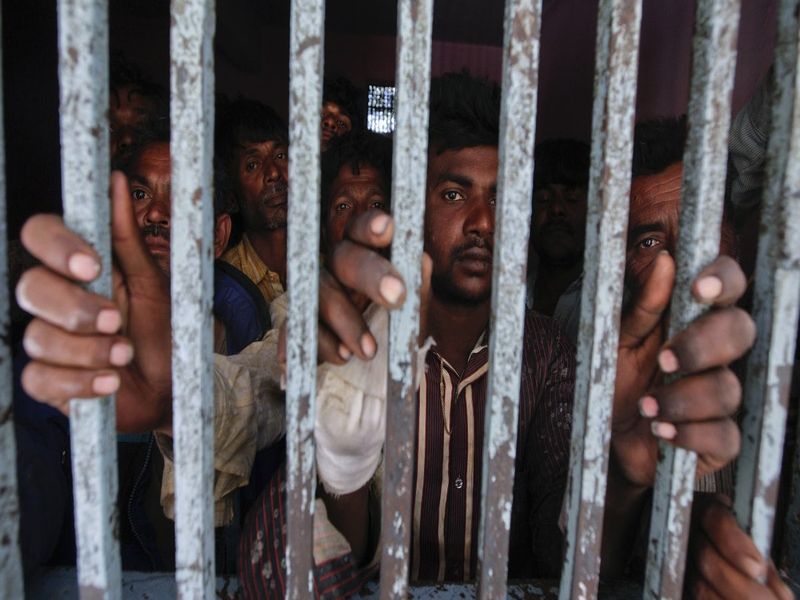
Crammed cells jam Indian jails.
For requests or suggestions: pr@indian-institute.com


Learn the official language of India in 30 days thanks to the most complete Grammar, Vocabulary and Culture courses available.
Start speaking Hindi today!
© Copyright 2026 Indian Institute
Come visit India!